
Detectable Mesh For Cable Marking
| Detectable Mesh For Cable Marking
|
Product Description
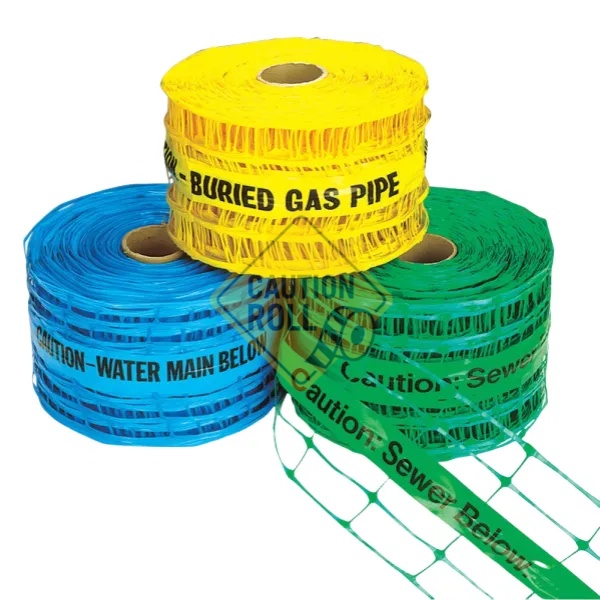
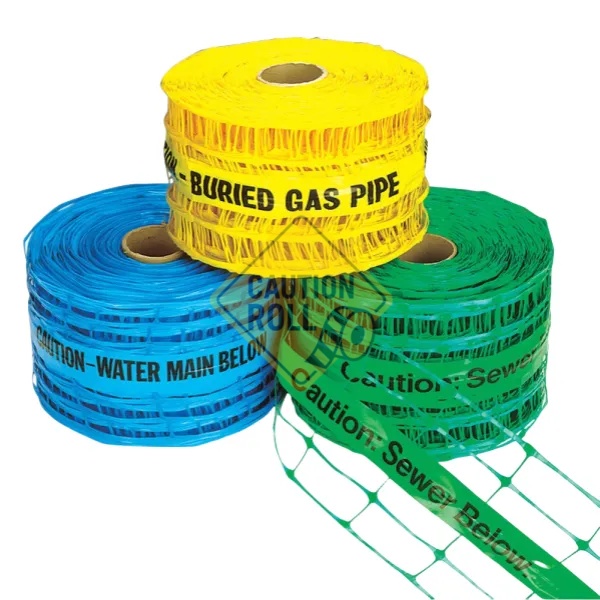
Caution Roll Company manufactures detectable mesh for cable marking as a custom roll-form solution for buried cable routes that need clear warning and reliable traceability after backfilling. The mesh combines a colored plastic warning layer, printed cable-below text, and a continuous tracer wire, helping maintenance crews identify the route before excavation reaches the cable zone. It is commonly used above power cables, fibre ducts, communication lines, and utility cable corridors.
Packing Photos
Product Overview
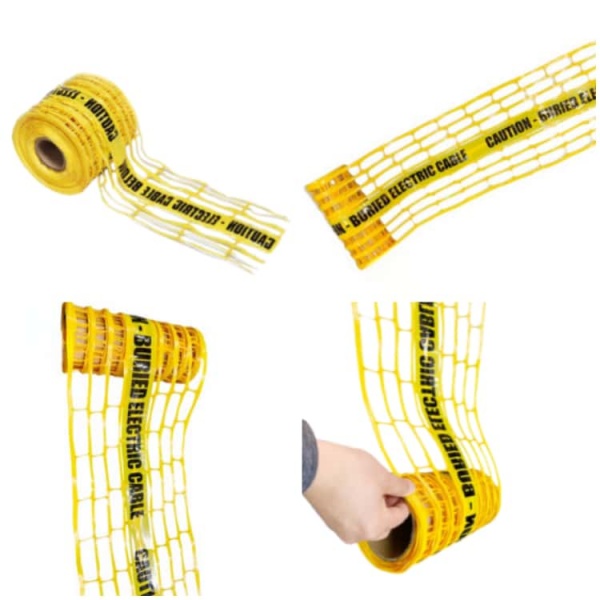
Detectable mesh for cable marking is made for underground cable corridors where ordinary warning tape may not give enough route visibility or detectable signal support. It combines a visible mesh warning layer with a continuous tracer wire, allowing compatible cable locators or CAT and Genny style equipment to trace the buried cable route from the surface after backfilling.
The mesh is supplied in 100 m, 200 m, and 365 m roll styles for different trench lengths. Common slit widths include 100 mm, 150 mm, 200 mm, and 300 mm, with repeated printed text such as ELECTRIC CABLE BELOW, FIBRE OPTIC CABLE BELOW, or POWER CABLE BELOW for clear trench recognition.
For cable route marking roll supply, small details matter in the field. A straight wire path, stable mesh opening, clear warning text, and consistent slit width all help installation teams lay the roll smoothly above the cable bedding layer. Factory reference checks include width tolerance within +/-5 mm, roll length tolerance within +/-2%, readable warning text after dry rub testing, and tracer wire continuity sampling before shipment.
Applications
- Underground power cable route marking
- Fibre optic duct and telecom cable corridors
- Street lighting cable trench identification
- Industrial plant buried cable routes
- Utility construction and maintenance projects
- Renewable energy site cable path marking
- Roadside communication cable installation
- Airport, port, and rail service cable zones
- Long trench routes where a continuous tracer wire is needed for later surface locating
- Power, fibre optic, and communication cable routes requiring printed warning text above the buried service
How does detectable mesh help locate buried cable routes after backfilling?
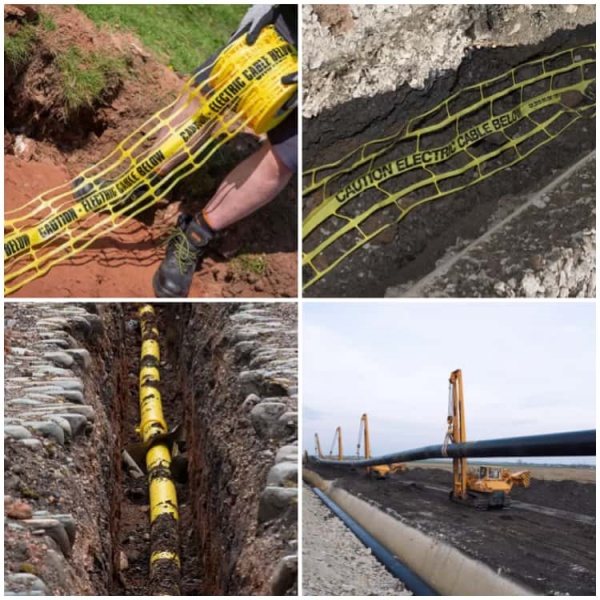
Detectable mesh works in two ways. If a trench is reopened, the colored mesh and printed cable-below text give a visual warning before the cable is exposed. If the route needs to be traced from the surface, the continuous tracer wire provides a signal path for compatible locating equipment. This is especially useful for fibre ducts, spare conduits, de-energized cables, and plastic cable routes where the service itself may not produce a strong detectable signal.
Technical Data Sheet
Item | Typical Value |
Product type | Detectable cable marking mesh roll |
Base material | HDPE or PP warning mesh |
Roll length options | 100 m, 200 m, 365 m |
Common slit widths | 100 mm, 150 mm, 200 mm, 300 mm |
Width tolerance | +/-5 mm factory reference |
Roll length tolerance | +/-2% factory reference |
Mesh color | Yellow, red, orange, blue, green, custom color |
Warning print | ELECTRIC CABLE BELOW, POWER CABLE BELOW, FIBRE OPTIC CABLE BELOW, custom text |
Print color | Black or custom high-contrast printing |
Tracer structure | Continuous stainless steel or metal detectable wire |
Locator compatibility | Standard cable locator, CAT and Genny style equipment |
Wire continuity check | Visual and continuity sampling before shipment |
Joining method | Wire crimp connector and crimping tool recommended |
Mesh tensile reference | 120-250 N/50 mm depending on width and material |
Elongation reference | 15%-35% depending on mesh structure |
Installation position | Above buried cable or duct route, below final backfill layer |
Soil exposure observation | No obvious cracking after damp soil storage test |
Operating temperature reference | -20 C to 60 C |
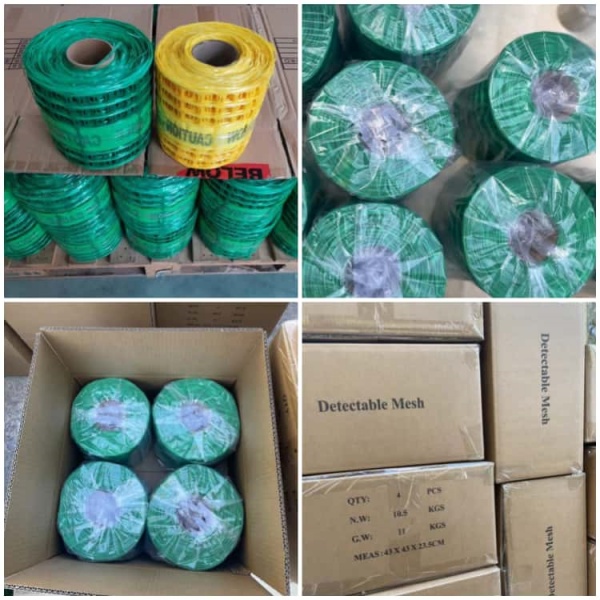
Packing style | Roll form with protective outer wrap |
Custom options | Width, roll length, color, text, tracer wire type |
Packaging & Shipping
Benefits
- Helps warn excavation crews before they reach the buried cable zone.
- Continuous tracer wire supports later surface locating after the cable route is covered.
- 100 m, 200 m, and 365 m roll styles reduce unnecessary joints on long trench runs.
- Slit widths of 100 mm, 150 mm, 200 mm, and 300 mm match narrow ducts and wider cable corridors.
- Printed cable-below text improves recognition during future excavation work.
- Colored mesh helps separate power, fibre, telecom, and other utility routes.
- Roll-to-roll joints can be connected with crimp connectors to keep the locator signal continuous.
- Custom printed cable warning mesh can match project language, route color, and cable type.
What should be checked when joining rolls of detectable cable marking mesh?
When a trench run needs more than one roll, the plastic mesh overlap is only part of the work. The tracer wire ends should be exposed, inserted into a suitable crimp connector, compressed with a crimping tool, and checked before backfilling. A weak connection may interrupt the signal path and make one section of the route harder to locate later. For this reason, roll quantity, crimp connectors, trench length, slit width, and printed warning text should be planned together before installation.
FAQ
Is this product the same as ordinary warning tape?
No. It is made for buried cable route marking, with a detectable tracer wire and mesh structure, not only surface warning text.
Can the roll length be customized?
Yes. Standard supply includes 100 m, 200 m, and 365 m styles, with project-based roll lengths available.
Can it be detected after backfilling?
Yes, when the tracer wire is continuous and correctly joined, it can support compatible cable locator detection from the surface.
Does the mesh provide mechanical cable protection?
No. It is mainly for visual warning and route detection. Where physical impact protection is required, it should be used together with cable covers or protection tiles.